
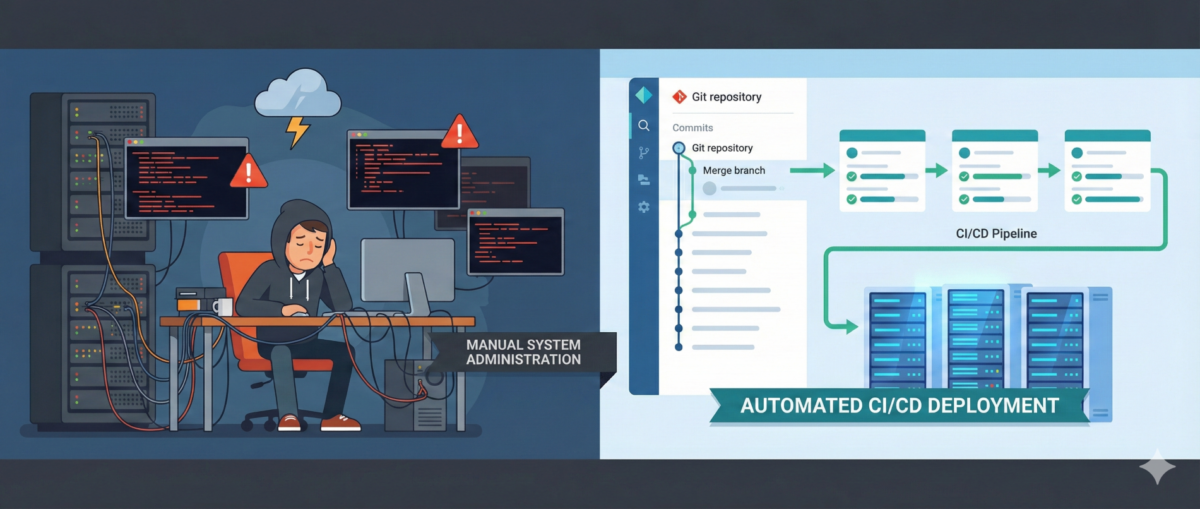
GitOps for Infrastructure Teams: From Manual Changes to Declarative Control
Infrastructure teams are under constant pressure: faster deployments, tighter security, more environments, more automation. Yet in many organizations, infrastructure changes still happen through SSH sessions, manual edits, and undocumented tweaks.
This is where GitOps changes the game.
GitOps is not just for Kubernetes-native startups. It is a powerful operating model for infrastructure, security baselines, configuration management, and even automation workflows.
This article explains how infrastructure teams can adopt GitOps pragmatically—without disrupting operations.
What Is GitOps (Beyond the Buzzword)?
At its core, GitOps means:
-
Git is the single source of truth
-
Desired system state is declared in code
-
Changes happen via pull requests
-
Automation reconciles actual state to desired state
-
Drift is detected and corrected automatically
It replaces:
-
“I logged into the server and changed it”
with: -
“I submitted a PR that changed the declared state”
Why Infrastructure Teams Struggle Without GitOps
1) Configuration Drift
Two servers built from the same template end up different over time.
Manual fixes, hot patches, and undocumented changes create invisible risk.
2) No Change Traceability
When an incident happens:
-
Who changed the firewall rule?
-
When was that service modified?
-
Why was that port opened?
Without Git history, answers are guesswork.
3) Security Blind Spots
Manual changes often bypass:
-
peer review
-
policy checks
-
security scanning
This creates compliance and audit risks.
Core Components of GitOps for Infra
You don’t need to start with Kubernetes to do GitOps.
1) Infrastructure as Code (IaC)
Use declarative tools like:
-
Terraform
-
Ansible (declarative mode)
-
Pulumi
-
CloudFormation
Infrastructure becomes version-controlled code.
2) Pull Request Workflow
Every change:
-
goes through PR
-
is reviewed
-
is validated automatically
-
is merged only if compliant
This adds:
-
accountability
-
collaboration
-
rollback capability
3) Automated Reconciliation
Automation ensures the real environment matches Git.
Examples:
-
CI/CD pipelines apply Terraform
-
Scheduled drift detection jobs
-
Controllers continuously reconciling state
No more silent drift.
GitOps in Real Infrastructure Scenarios
Scenario 1: Firewall Changes
Old way:
-
SSH into firewall
-
Add rule
-
Forget to document it
GitOps way:
-
Modify firewall rule in code
-
PR reviewed
-
Automated validation checks policy
-
Change applied through pipeline
-
Audit trail preserved
Scenario 2: Linux Server Baseline Hardening
Instead of manually:
-
disabling services
-
editing sysctl
-
adjusting SSH configs
Define:
-
baseline role in Ansible
-
security profile in code
-
versioned config
Drift detection alerts if someone changes settings manually.
Scenario 3: n8n Workflow Deployment
Even automation platforms benefit from GitOps.
Instead of:
-
editing workflows directly in UI
You:
-
export workflows as JSON
-
store in Git
-
review changes
-
deploy via pipeline
Now automation itself is controlled and auditable.
The Security Benefits of GitOps
1) Least Privilege Enforcement
Direct production access can be reduced:
-
Engineers don’t need SSH for routine changes.
-
Pipelines execute approved changes.
2) Audit-Ready by Design
Git history becomes:
-
change log
-
approval record
-
rollback mechanism
3) Faster Incident Recovery
Rollback = revert commit + pipeline run.
No guessing what “used to work.”
A Practical Adoption Roadmap
Phase 1: Version Everything
-
Move infra configs to Git
-
Protect main branch
-
Enforce PR reviews
No automation changes yet—just discipline.
Phase 2: Add Automated Validation
-
Linting
-
Policy-as-code checks
-
Security scanning
-
Plan previews (e.g., Terraform plan in PR)
Phase 3: Restrict Manual Production Changes
-
Limit direct SSH
-
Require pipeline for infra updates
-
Monitor drift
Phase 4: Continuous Reconciliation
-
Scheduled drift detection
-
Automated correction (where safe)
-
Alerting on unauthorized changes
Common Mistakes
“GitOps means no humans touch prod.”
Not realistic. Break-glass access must exist—but logged and controlled.
“We need Kubernetes first.”
False. GitOps is an operational model, not a platform requirement.
“It slows us down.”
Initially, yes.
Long term: fewer outages, faster rollbacks, stronger security.
Conclusion
GitOps is not about tools.
It’s about control, visibility, and repeatability.
For infrastructure teams, it means:
-
fewer midnight surprises
-
better audit posture
-
safer automation
-
and less reliance on fragile tribal knowledge
Manual changes scale chaos.
Declarative control scales stability.